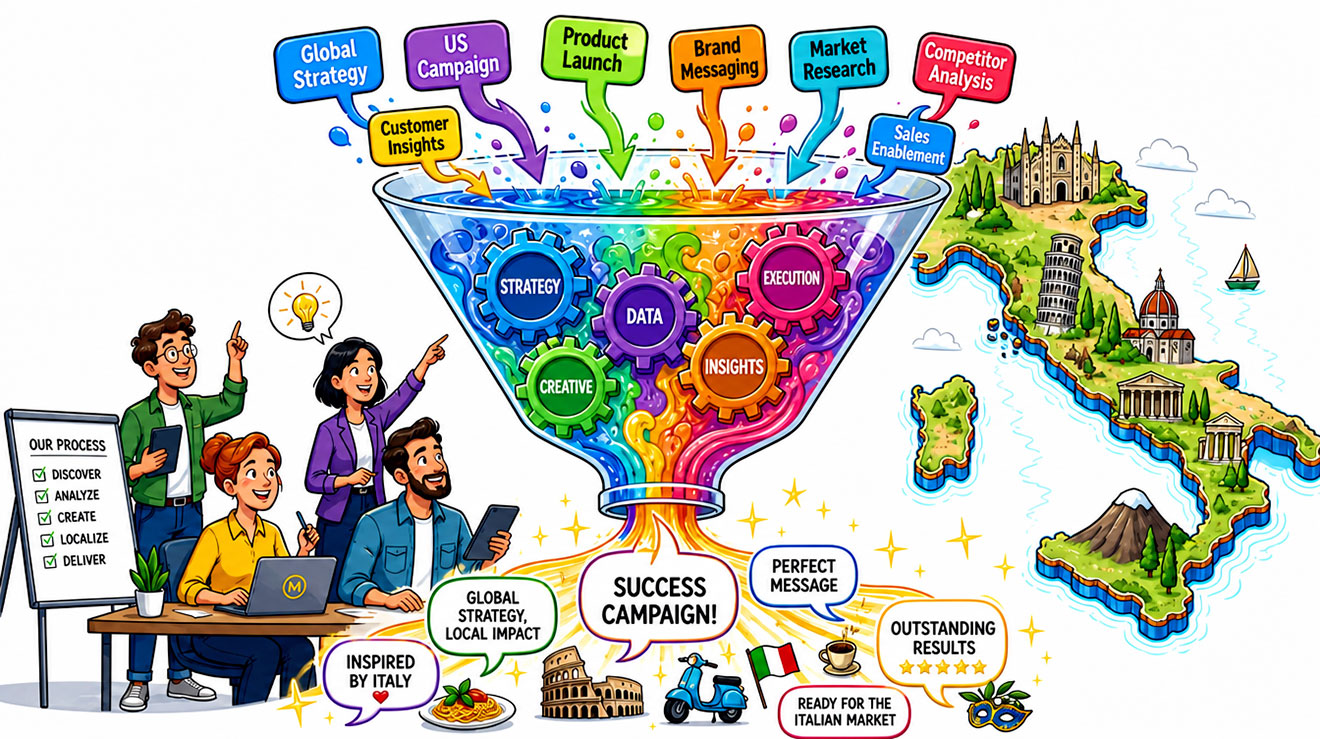
The Reality Behind Marketing Strategies in Italy
Expanding into Italy can look straightforward from the outside. The country shares a common language, national television networks, and the same global digital platforms used across Europe.
For many international companies, that creates the impression of a relatively uniform market. In practice, however, Italy is far more nuanced. Consumer behavior, purchasing habits, business culture, and communication styles often vary from one region to another. What works in Milan may not generate the same response in Venice, Bologna, Rome, Naples, or Palermo.
This doesn't mean brands need twenty different campaigns. It means that effective marketing strategies in Italy require a deeper understanding of local dynamics and a willingness to adapt messaging, media planning, and positioning to different audiences.
At Eden Exit, we help international companies bridge that gap by transforming global marketing strategies into campaigns that resonate with Italian consumers and decision-makers without losing the original brand identity.
Is Italy Really One Market?
Not exactly.
Italy is united politically and linguistically, but regional identities remain remarkably strong. Historical, economic, and cultural differences continue to influence how people buy products, evaluate brands, and build trust.
Before launching a campaign, international companies should ask themselves a few key questions:
- Are we targeting consumers or businesses?
- Is our audience concentrated in Northern Italy or spread across the country?
- Does our message emphasize innovation, efficiency, trust, tradition, or price competitiveness?
- Have we validated our positioning with Italian buyers?
- Are we relying on direct translation instead of cultural adaptation?
The answers often have a greater impact on performance than the advertising budget itself.
Successful marketing strategies in Italy are rarely built around assumptions. They are built around understanding how different audiences perceive value.
What Changes Between Northern and Southern Italy?
One of the biggest mistakes international companies make is assuming that consumer psychology remains consistent throughout the country.
While there are many similarities, regional differences still influence purchasing behavior and communication preferences.
As a general rule:
- Northern Italy tends to respond strongly to efficiency, innovation, productivity, measurable results, and practical value.
- Central Italy often combines business pragmatism with stronger emphasis on reputation and relationship-building.
- Southern Italy frequently places greater importance on trust, community, personal recommendations, and long-term credibility.
These differences do not require completely different brands. However, they often require adjustments in tone of voice, creative storytelling, advertising channels, and customer acquisition strategies.
The goal is not to change who you are. The goal is to communicate your value in a way that feels relevant to local audiences.
A Practical B2C Example
Imagine a digital subscription service entering the Italian market. A campaign focused on speed, automation, and efficiency may perform exceptionally well among professionals in Milan, Verona, Padua, or other highly industrialized areas.
The same message may feel cold or overly aggressive in regions where purchasing decisions rely more heavily on trust, familiarity, and personal recommendations.
In those contexts, advertising often performs better when it emphasizes:
- reliability;
- human relationships;
- customer support;
- community;
- long-term value.
Both approaches can be effective. The challenge is understanding which one should take priority for the audience you are trying to reach.
A Practical B2B Example
The same principle applies to B2B marketing.
Companies selling industrial machinery, software, consulting services, logistics solutions, or manufacturing technologies often discover that the sales process varies significantly across different parts of Italy.
In many Northern regions, decision-makers tend to focus heavily on:
- ROI;
- efficiency gains;
- cost reduction;
- production optimization;
- technical performance.
In other areas, purchasing decisions may involve longer evaluation cycles and a stronger emphasis on personal relationships before commercial discussions move forward.
For international sales teams unfamiliar with these dynamics, this can create frustration.
The issue is rarely the product itself. More often, it is a mismatch between the communication style and local business expectations.
Understanding these differences allows companies to generate better leads, reduce sales friction, and improve conversion rates.
Why Media Buying in Italy Is More Complex Than It Looks
Understanding the audience is only part of the challenge.
Executing marketing strategies in Italy also requires navigating one of Europe's most fragmented media landscapes.
Many international companies assume they can replicate the same media planning model used in Germany, the United Kingdom, or the United States.
In reality, the Italian market operates differently.
While platforms such as Google, YouTube, LinkedIn, Meta, and TikTok are available everywhere, local media still plays a significant role in many sectors.
This becomes particularly important when campaigns involve:
- out-of-home advertising;
- regional newspapers;
- local online publications;
- radio networks;
- territorial awareness campaigns;
- B2B industrial markets.
Many of these assets are not managed through a single national organization. Instead, they are controlled by hundreds of independent concessionaires operating at regional and local levels.
The Media Fragmentation Challenge
Imagine launching a nationwide billboard campaign in support of a new industrial service.
In some countries, you may work with one or two major operators.
In Italy, covering several productive regions can require coordination with multiple local concessionaires, each with different pricing structures, contracts, availability, and operational procedures.
The same applies to regional radio stations, local newspapers, and city-level digital publishers.
Without local knowledge, companies often encounter:
- higher media costs;
- slower execution;
- bureaucratic complexity;
- duplicated negotiations;
- inefficient media distribution.
This is why many international brands choose to work with local partners who already understand the ecosystem and maintain relationships with regional media operators.
Eden Exit acts as a single point of coordination, helping companies simplify media buying while maintaining national coverage and local relevance.
Is Translation Enough for the Italian Market?
In most cases, no. While translation changes the language, it does not automatically adapt the message.
Italian consumers and decision-makers interpret communication through their own cultural references, social habits, and expectations. A slogan that performs exceptionally well in London, New York, or Berlin may sound unnatural, or simply irrelevant when translated word for word.
Italy has one of the oldest populations in Europe, and many business owners, executives, and purchasing managers still prefer communication that feels local, clear, and familiar.
Using excessive English terminology or untranslated corporate jargon can create unnecessary distance between your brand and your audience.
Why Italian Buyers Respond to Localized Communication
Trust plays a central role in Italian purchasing decisions. Whether you are targeting consumers or businesses, people tend to engage more easily with brands that demonstrate a genuine understanding of their market.
Localized communication helps achieve that goal.
Effective marketing strategies in Italy often require adjustments to:
- tone of voice;
- visual storytelling;
- calls-to-action;
- cultural references;
- product positioning;
- sales messaging.
The goal is not to reinvent your brand. The goal is to remove barriers that prevent your audience from immediately understanding its value.
How We Help International Companies Enter Italy
At Eden Exit, we support international brands through a combination of strategic consulting, localization expertise, and practical campaign execution.
Our role is to simplify the complexity of the Italian market while preserving the integrity of your global brand.
Depending on your objectives, we can support:
- Regional Audience Profiling: Identifying how different Italian audiences perceive products, services, and value propositions.
- Marketing Strategies in Italy: Developing market-entry plans adapted to local cultural and commercial realities.
- Transcreation and Localization: Adapting campaigns, websites, landing pages, advertising assets, and sales materials for Italian audiences.
- Media Planning and Buying: Coordinating digital, traditional, and regional media placements.
- B2B Market Development: Supporting lead generation, distributor communication, and commercial expansion initiatives.
- Digital Marketing: SEO, SEM, paid media, social advertising, and content strategies designed for Italian search and consumer behavior.
Every project begins with understanding where your company is today and where you want to be tomorrow.
Demonstrated Experience Across Industries and Markets
Our work spans local businesses, national organizations, and international brands entering or expanding within the Italian market. From digital positioning and lead generation to market-entry planning and B2B growth strategies, we help companies adapt their communication to different commercial environments while maintaining clear business objectives.
- LeanIT (Specialized B2B & Regulated Industries)
For LeanIT, a software provider operating between Switzerland and Italy and focused on the pharmaceutical sector, we developed a tailored marketing framework and digital positioning strategy. The project demonstrates our ability to work within highly specialized industries where technical expertise, compliance considerations, and long sales cycles require a more strategic approach. - SEISETA (International B2B Expansion)
We support SEISETA with B2B marketing initiatives, digital positioning, and multi-channel communication activities targeting Italy, Europe, and the United States. Our role focuses on aligning international business objectives with localized execution across multiple markets. - MMB Software (Italian B2B Lead Generation)
For MMB Software, we manage digital advertising, lead generation campaigns, and visibility initiatives designed to strengthen the company's presence within the Italian market. The project reflects our experience navigating complex B2B purchasing processes and relationship-based decision-making environments. - Cattier Paris (Italian Market Localization Strategy)
We designed a localized market-entry and digital marketing strategy for the French beauty brand Cattier Paris as part of its evaluation of the Italian market. Due to existing non-disclosure agreements, the full project cannot be published publicly. However, we are able to discuss the methodology, research process, and strategic framework during an introductory consultation.
Request a Strategy Consultation
Tell us more about your project and we will help you evaluate the most effective approach for entering or expanding within Italy.
- Name & Corporate Email
- Company Name & Current Website
- Primary Goals (Market Testing, Brand Awareness, B2B Lead Generation, Sales Support)
- Message / Project Requirements
Frequently Asked Questions
Why can't we simply use our existing European campaign?
Because consumer expectations, business culture, and communication preferences vary significantly across Italy. A direct translation often fails to create the same emotional response or level of trust.
How important is transcreation for marketing strategies in Italy?
It is often one of the most important factors. Transcreation allows brands to preserve their identity while adapting communication to local cultural expectations and buying behavior.
Do we need separate campaigns for every Italian region?
Not necessarily. Most brands benefit from a unified strategy with targeted regional adjustments where needed. The objective is consistency combined with local relevance.
Can you manage both digital and traditional media?
Yes. We regularly combine SEO, paid media, social advertising, content marketing, local press, radio, and out-of-home advertising to create integrated marketing strategies in Italy.
Do you work with international teams?
Absolutely. We collaborate daily with companies from the United States, the United Kingdom, Germany, Northern Europe, and other international markets, providing bilingual communication and transparent reporting throughout every project.